When we talk about education, most people think about completing school, earning a college degree, pursuing higher studies and then building a career around one particular field. But what if one person decided to study medicine, law, business, journalism, economics, history, philosophy, political science, Sanskrit and several other subjects while also entering the civil services and politics?
That remarkable person was Dr. Shrikant Jichkar.
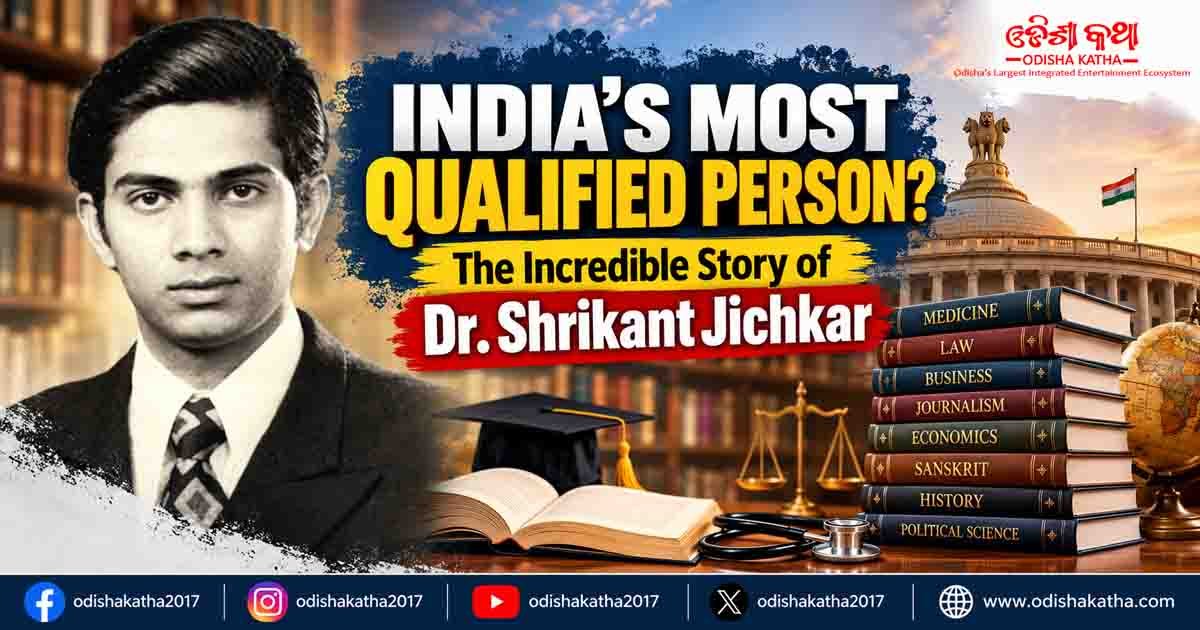
He is widely remembered as one of India’s most highly qualified individuals, and the Limca Book of Records listed him as the most qualified person in the country. His academic journey was extraordinary not simply because of the number of qualifications he earned, but because of the enormous variety of subjects he chose to study. Dr. Jichkar’s life is a fascinating example of curiosity, discipline and lifelong learning.
Who Was Dr. Shrikant Jichkar?
Dr. Shrikant Ramchandra Jichkar was born on 14 September 1954 in Maharashtra. He was much more than a person with a long list of academic qualifications. During his relatively short life, he became a doctor, civil servant, politician, educationist and scholar, while also developing interests in areas such as photography, painting, acting and literature. His academic interests crossed traditional boundaries.
Instead of concentrating on only one profession, he continued studying different subjects and acquiring qualifications in fields that were very different from one another. This unusual approach eventually made him famous across India.
How Many Degrees Did Shrikant Jichkar Have?
Dr. Jichkar is widely reported to have earned 20 degrees and qualifications after appearing for 42 university examinations between 1973 and 1990. The remarkable part of his educational journey was not only the number of examinations he appeared for, but also the range of subjects he studied.
His qualifications included medicine, law, business administration, journalism, public administration, sociology, economics, Sanskrit, history, English, philosophy, political science and ancient Indian history, culture and archaeology. Several accounts also note that he achieved first-division results and received gold medals in a number of his academic pursuits. Rather than treating education as a single destination, Jichkar appeared to treat it as a lifelong journey.
A Journey That Began With Medicine
Dr. Jichkar’s first major academic path was medicine. He completed his MBBS and later obtained an MD.
For most students, completing medical education and becoming a doctor would itself represent a major academic achievement.
For Jichkar, however, medicine was only the beginning. After studying medicine, he moved into completely different areas of education.
He studied law and obtained qualifications including LLB and LLM in International Law. He also pursued business management and journalism. His educational journey continued into the humanities and social sciences.
His Remarkable Range of Subjects
One of the most fascinating aspects of Dr. Jichkar’s education was the diversity of subjects he studied. His qualifications are associated with areas including:
Medicine
Law
International Law
Business Management
Journalism
Public Administration
Sociology
Economics
Sanskrit
History
English
Philosophy
Political Science
Ancient Indian History, Culture and Archaeology
Psychology
Sanskrit literature at the doctoral level
He also earned a Doctor of Letters (D.Litt.) in Sanskrit. This combination of scientific, professional, social-science and humanities education was extremely unusual. It is this extraordinary academic breadth that continues to make his story interesting even decades after his death.
He Also Cleared the Civil Services Examinations
Dr. Jichkar’s achievements were not limited to university education.
He also successfully entered India’s civil services.
He joined the Indian Police Service in 1978.
Later, in 1980, he joined the Indian Administrative Service.
The Rajya Sabha’s official records confirm both of these milestones.
His transition from medicine and higher education to India’s elite civil services demonstrates the extraordinary range of his abilities and ambitions.
But even the civil services were not the final destination for him.
He eventually moved into public life and politics.
From Civil Services to Politics
Dr. Jichkar entered electoral politics at a remarkably young age.
He became a member of the Maharashtra Legislative Assembly and subsequently served in the Maharashtra Legislative Council.
He also served as a Minister of State in the Maharashtra Government.
His political career later took him to the Rajya Sabha, where he served as a Member of Parliament from 1992 to 1998.
The official parliamentary record also notes that he received the Ten Outstanding Young Persons of the World Award in 1983.
His career therefore combined three worlds that are rarely seen together in one person’s life — academic scholarship, public administration and politics.
A Personal Library of Thousands of Books
Perhaps one of the strongest indications of Jichkar’s love for learning was his personal library.
He reportedly had a collection of approximately 52,000 books.
For someone who had already studied such a wide range of subjects, the enormous library seems fitting.
Books were clearly more than academic resources for him. They were part of his intellectual life.
His interests extended beyond formal education as well. He was known for his interest in photography, painting and stage acting.
This makes his story even more interesting because his personality was not restricted to examinations and degrees.
His Contribution to Education
Dr. Jichkar also believed in education beyond his own personal achievements.
He founded Sāndipani School in Nagpur, an institution that continues to operate today.
The school’s philosophy reflects an emphasis on education, values, personality development and learning beyond textbooks.
His association with Sanskrit and Indian philosophical traditions also continued beyond his formal academic qualifications.
His educational vision therefore extended from his own pursuit of knowledge to creating opportunities for others to learn.
Was Dr. Shrikant Jichkar Really the Most Educated Person in India?
This question needs a little explanation.
There is no universally accepted scientific measurement for determining who is the “most educated person” in an entire country.
Education can be measured in many different ways.
For example, someone might have:
The highest academic qualification in a particular field
The largest number of research publications
The greatest number of doctoral degrees
Exceptional scientific achievements
The largest number of academic degrees
Major contributions to education or research
Therefore, calling someone the “most educated person in India” depends on the definition being used.
In Dr. Jichkar’s case, however, there is a particularly strong historical basis for the description.
The Limca Book of Records listed him as the most qualified person in the country, while his academic record included an extraordinary number and variety of qualifications.
So, rather than saying that he was unquestionably the most intelligent or academically superior Indian, it is more accurate to describe him as one of India’s most highly qualified and academically diverse individuals.
Why Dr. Jichkar’s Story Still Matters
The most interesting lesson from Dr. Jichkar’s life is not simply the number of degrees he earned.
It is his attitude towards learning.
In today’s world, education is often treated as a means to obtain a job or promotion.
Jichkar’s journey presents a very different idea.
He studied subjects that were not necessarily connected to one single career.
Medicine led to law.
Law led to business and other areas.
His interests extended into Sanskrit, philosophy, history, political science and social sciences.
He demonstrated that curiosity does not necessarily have to stop when a person gets a job.
Learning can continue throughout life.
A Life That Ended Too Soon
Despite his extraordinary achievements, Dr. Jichkar’s life was tragically short.
He died in a car accident on 2 June 2004, at the age of 49.
His death brought an early end to the life of a person who had managed to explore an extraordinary number of academic and professional fields within a few decades.
But his story has continued to attract attention.
Even years after his death, people continue to discover his achievements and ask how one person could accomplish so much in a single lifetime.
The Bigger Lesson From India’s Most Qualified Person
Dr. Shrikant Jichkar’s story is ultimately not about collecting degrees.
It is about curiosity.
A degree can prove that a person completed a course of study, but genuine education goes beyond certificates.
It is about asking questions, developing new interests, understanding different subjects and continuing to learn even after formal education has ended.
That may be the most valuable part of Jichkar’s legacy.
He showed that a person does not always have to choose between science and humanities, professional education and culture, or career and intellectual curiosity.
Sometimes, the desire to learn can cross every boundary.
And that is why Dr. Shrikant Jichkar continues to be remembered as one of the most extraordinary educated personalities in India’s modern history.
Frequently Asked Questions
Who is considered the most educated person in India?
Dr. Shrikant Jichkar is widely regarded as one of India’s most qualified people and was listed in the Limca Book of Records as the most qualified person in the country.
How many degrees did Shrikant Jichkar have?
He is widely reported to have earned around 20 degrees and qualifications after appearing for 42 university examinations between 1973 and 1990.
Was Shrikant Jichkar an IAS officer?
Yes. He joined the Indian Administrative Service in 1980 after previously joining the Indian Police Service in 1978.
Was Shrikant Jichkar a politician?
Yes. He served in the Maharashtra Legislative Assembly, Maharashtra Legislative Council, Maharashtra Government and later the Rajya Sabha.
How many books were in Shrikant Jichkar’s personal library?
His personal library reportedly contained approximately 52,000 books.
When did Shrikant Jichkar die?
Dr. Shrikant Jichkar died in a car accident on 2 June 2004, aged 49.
What can we learn from Shrikant Jichkar?
His life demonstrates the value of curiosity, discipline and lifelong learning. His academic journey shows that education does not have to be limited to one subject or one profession.
Disclaimer
This article is intended for general informational and educational purposes. Information has been compiled and presented based on publicly available historical and biographical records. While reasonable care has been taken to maintain accuracy, readers are advised to independently verify specific historical or academic details where required. Odisha Katha does not claim that the term “most educated person” represents an absolute or universally accepted ranking.